
A Framework For Understanding The High-Level 3.5
For years I assumed the High-Level 3.5 was a rating category. Further analysis suggests it is an identity: always improving, never arriving.

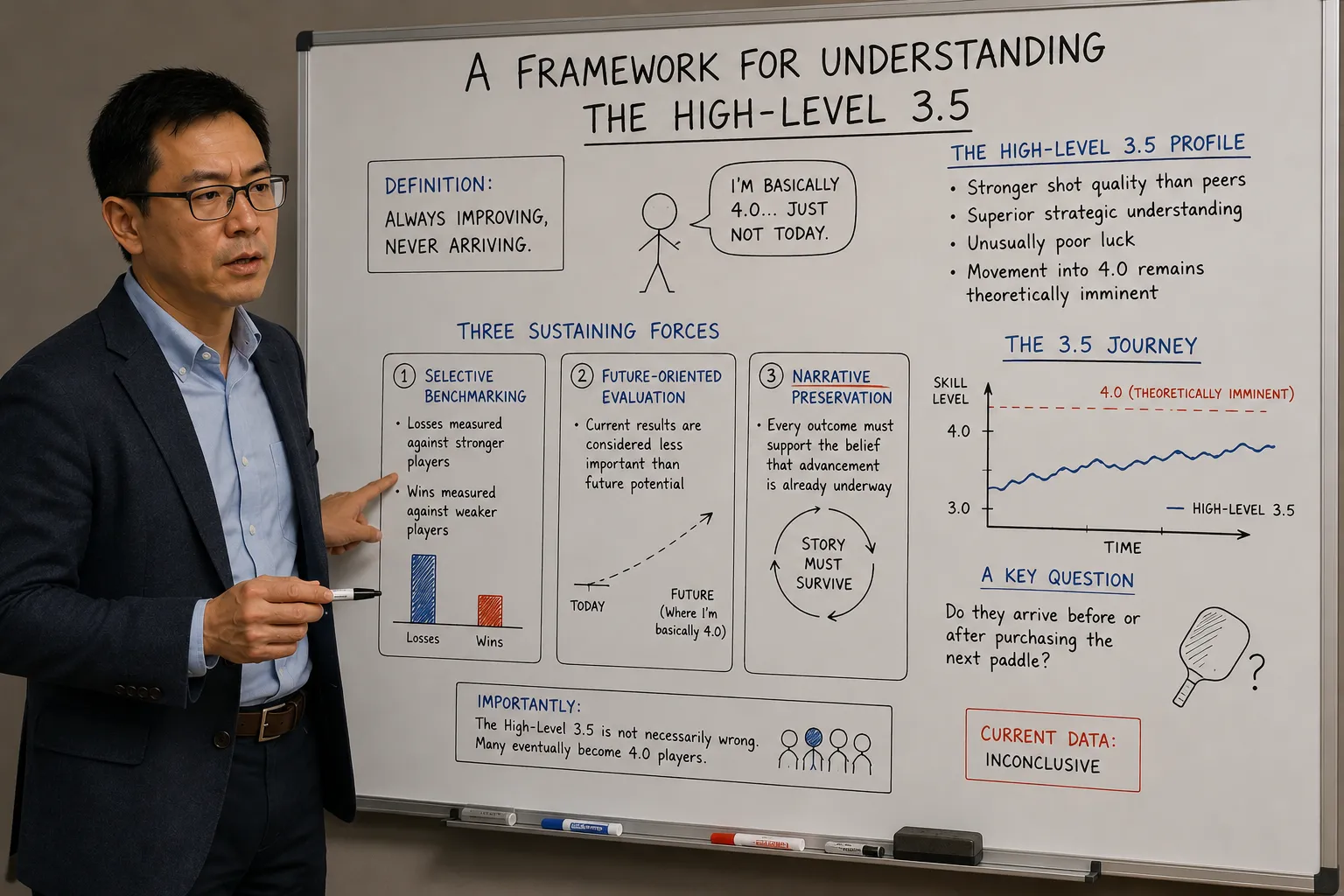
Few figures in recreational pickleball have generated more discussion than the High-Level 3.5.
For years I assumed this was a rating category.
Further analysis suggests it is an identity.
The High-Level 3.5 occupies a unique position within the competitive ecosystem.
Specifically:
They are always improving.
They are never arriving.
The High-Level 3.5 often reports:
- stronger shot quality than peers,
- superior strategic understanding,
- and unusually poor luck.
Movement into 4.0 remains theoretically imminent.
This condition may persist indefinitely.
My research indicates the High-Level 3.5 is sustained by three forces:
1. Selective Benchmarking
Losses are measured against stronger players.
Wins are measured against weaker players.
2. Future-Oriented Evaluation
Current results are considered less important than future potential.
3. Narrative Preservation
Every outcome must support the belief that advancement is already underway.
Importantly, the High-Level 3.5 is not necessarily wrong.
Many eventually become 4.0 players.
The fascinating question is whether they arrive before or after purchasing the next paddle.
Current data remains inconclusive.