
How To Beat Pickleball Bangers
The banger is not a player. The banger is a system. And like any system, the data suggests, he can be modeled, contained, and — eventually — disappointed into submission.

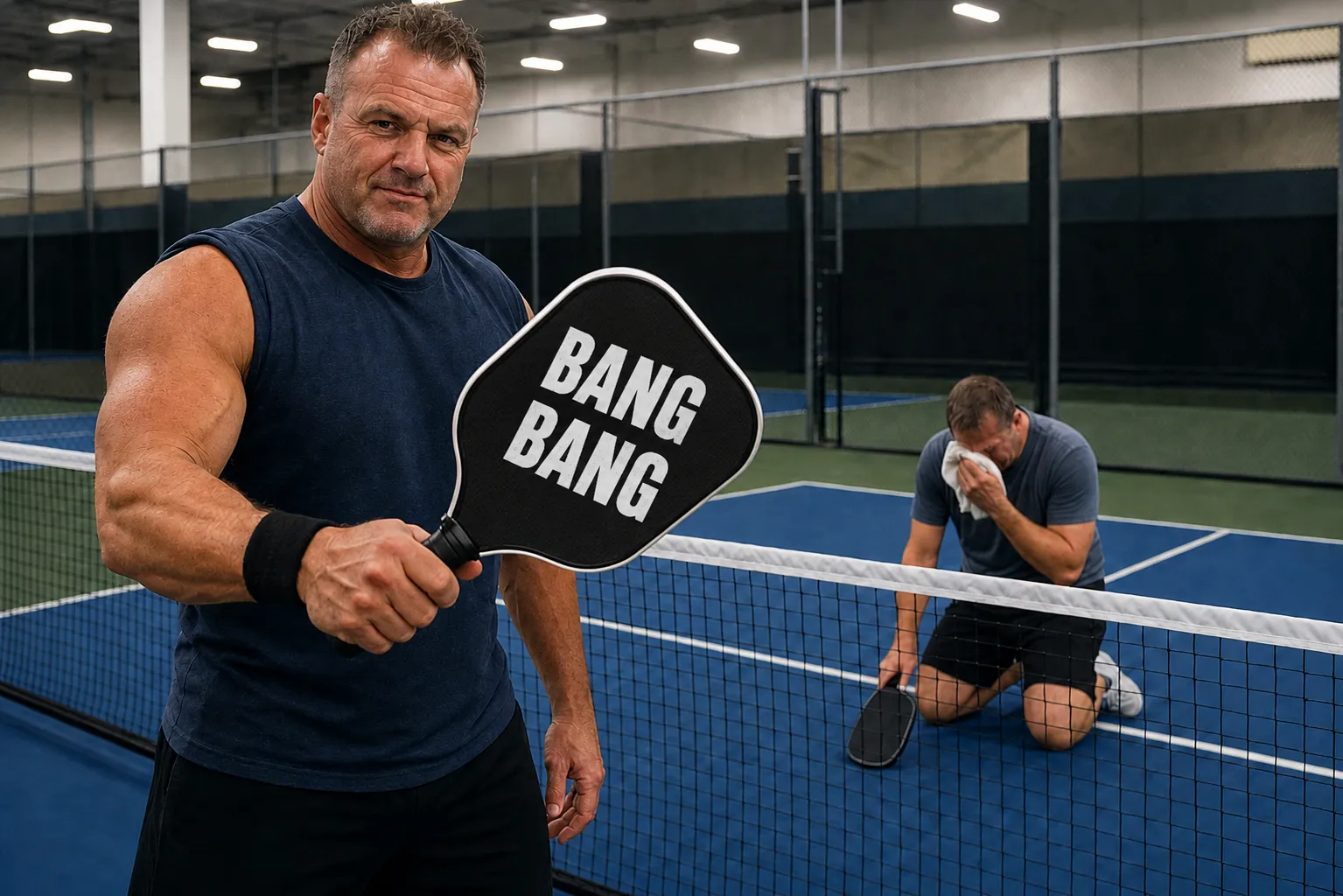
The banger is the most misunderstood archetype in recreational pickleball. Players treat him as a personality. This is an error. The banger is a system: a closed loop in which force is the input, force is the strategy, and force is the only available response to force not working.
Understanding this is the first step to beating him.
I have spent the season developing the Banger Containment Model™, a four-stage framework derived from 140 logged points against self-identified “aggressive players.” The model is reproducible. It is also, I will concede in advance, simpler than it appears, though arriving at the simplicity requires the framework.
Stage 1: Profile the input. The banger has one club in the bag and it is labeled HARDER. Testing indicates he does not soften under pressure; he intensifies. Any strategy premised on him “settling down” is not a strategy. It is a hope.
Stage 2: Remove the target. The banger requires pace to generate pace. Deny him the feed. Observed behavior supports that a ball arriving slow, low, and without momentum presents the banger with a problem he has never once practiced: a decision.
Stage 3: Reset, repeat, wait. This is where most players fail. They abandon the model after two points because absorbing a banger’s drive and dropping it softly into the kitchen is, in the moment, deeply unsatisfying. The Recreational Frustration Matrix™ indicates the banger’s error rate climbs sharply after the seventh consecutive reset. You must reach the seventh reset. Most players quit at four.
Stage 4: Allow the system to defeat itself. You do not beat the banger. The banger beats the banger, somewhere around 9–7, by attempting a put-away from a ball that gave him nothing to put away.
I recognize that all four stages reduce, functionally, to a single instruction: let the ball slow down and put it back gently. I have chosen to call this “vertical deceleration tolerance” because the plain version does not adequately convey the discipline required.
Further testing is warranted. The banger, notably, will not be conducting any.